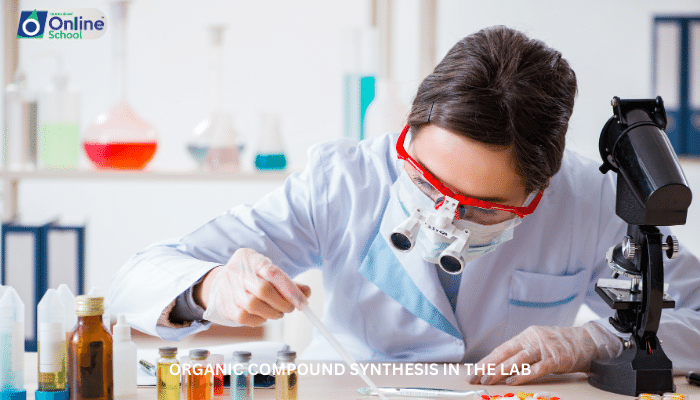
Learning Outcomes
i. Comprehend the basic principles of organic compound synthesis in the laboratory.
ii. Identify and describe common laboratory techniques used in organic synthesis, including distillation, crystallization, and chromatography.
iii. Analyze the significance of safety precautions and proper laboratory practices in organic synthesis.
iv. Explain the importance of characterization techniques, such as melting point determination and spectroscopic analysis, in confirming the identity of synthesized organic compounds.
v. Appreciate the role of laboratory synthesis in the development of new drugs, materials, and other valuable organic compounds.
Introduction
While nature provides a vast array of organic compounds, the ability to synthesize organic molecules in the laboratory has revolutionized various fields, including medicine, materials science, and industrial chemistry. In this lesson, we will delve into the world of laboratory organic synthesis, exploring the methods, techniques, and considerations involved in creating new organic compounds in a controlled environment.
i. Laboratory Techniques in Organic Synthesis
Organic synthesis encompasses a wide range of laboratory techniques, each tailored to specific reactions and desired products:
Distillation: Distillation involves separating a mixture of liquids based on their boiling points. This technique is used to purify organic compounds and isolate them from reaction mixtures.
Crystallization: Crystallization relies on the solubility differences of solids in different solvents. Crystals of the desired compound are formed from a concentrated solution, allowing for purification and isolation.
Chromatography: Chromatography is a separation technique based on the distribution of compounds between a stationary phase and a mobile phase. It is employed to purify and isolate compounds from mixtures based on their different affinities for the phases.
ii. Safety Considerations and Laboratory Practices
Safety is paramount in organic synthesis due to the potential hazards associated with chemicals, solvents, and laboratory equipment:
Personal Protective Equipment: Proper personal protective equipment (PPE), including gloves, lab coats, safety goggles, and closed-toe shoes, is essential to minimize exposure to hazardous substances.
Fume Hoods: Fume hoods are designed to remove hazardous fumes and vapors from the laboratory environment, protecting the health of the chemist.
Waste Disposal: Proper disposal procedures for chemicals, solvents, and reaction byproducts are crucial to prevent environmental contamination.
iii. Characterization of Synthesized Organic Compounds
Confirming the identity and purity of synthesized organic compounds is essential in organic synthesis:
Melting Point Determination: Melting point determination measures the temperature at which a solid compound melts, providing a characteristic property for identification.
Spectroscopic Analysis: Spectroscopic techniques, such as nuclear magnetic resonance (NMR) spectroscopy and infrared (IR) spectroscopy, provide detailed information about the structure and functional groups of organic compounds.
iv. Significance of Laboratory Synthesis
Laboratory organic synthesis plays a pivotal role in various fields:
Drug Discovery and Development: The synthesis of new drugs and therapeutic agents relies heavily on laboratory organic synthesis.
Materials Science: The development of novel materials, such as polymers, plastics, and advanced composites, involves the synthesis of tailored organic compounds.
Industrial Chemistry: The production of various chemicals, such as dyes, flavors, and fragrances, depends on laboratory organic synthesis techniques.
Organic compound synthesis in the laboratory is a dynamic and multifaceted field that bridges the gap between theoretical organic chemistry and practical applications. By employing a range of laboratory techniques, adhering to safety precautions, and utilizing characterization methods, chemists can create new organic compounds with diverse properties and applications, shaping the future of various fields.
